I Love It. But Does It Belong Here?
I go into antique stores prepared.
I usually know what I’m looking for. I have measurements written down, and I keep a tape measure strapped to my jeans because I’ve learned that I think it’ll fit is not, in fact, a unit of measurement.
I am a woman with a plan.
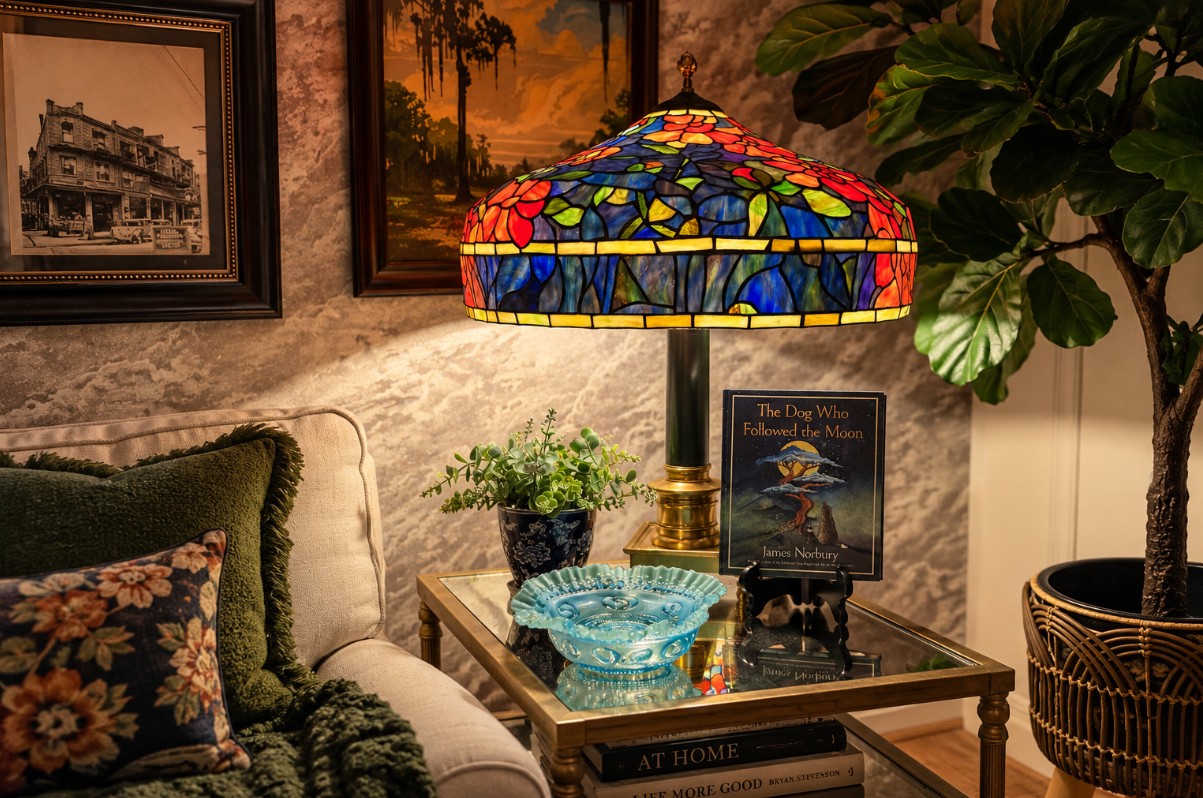
This is how I once walked into an antique store looking for something else entirely and walked out with a very large Tiffany-style lamp.
Antique stores do this to me.
I can be completely focused on finding a particular table or chair, and then something catches my eye from three booths away.
Squirrel.
Suddenly I’m inspecting a painting I didn’t know I needed or measuring a piece of furniture that has absolutely nothing to do with why I came.
This has become considerably more complicated since my son bought his house a couple of years ago and asked me to help him decorate it. Now I’m essentially shopping for two homes at once.
Mine has its own personality, accumulated over years. His is still becoming itself. We’re creating something more masculine and collected for him, with a Ralph Lauren sensibility—warm woods, leather, plaid, antiques, pieces with some age and character.
So I can walk past something that isn’t remotely right for my house and immediately think, Adam.
Then I start measuring.
I arrive with a plan, measurements and a tape measure. Apparently none of these protects me from squirrels.
The tape measure is important because enthusiasm has a remarkable ability to alter my perception of physical space.
Chairs have been particularly good at teaching me this.
I’ve found chairs for Adam’s house that I loved. Beautiful shape. Great fabric. Right amount of character. Then I measured them.
No.
A chair doesn’t care how much I love it. If it’s too large for the room, it’s too large for the room. I can stand there and admire it. I can calculate whether moving three other pieces of furniture might somehow change the laws of geometry. I can note that the price is really good.
The chair remains the same size.
Other chairs have passed the tape-measure test and still been wrong.
That’s harder.
There’s nothing objectively wrong with them. They may be beautiful. They may even be a great price, which introduces an entirely different form of temptation because apparently a discount can make me briefly reconsider my entire design direction.
But when I picture them with everything else we’re putting together, they don’t belong.
They tell a different story.
I’ve had to learn that I love this and this belongs in the room are two entirely different decisions.
That sounds obvious until you’re standing in an antique store looking at something wonderful that is also one of a kind.
Because that’s part of the trouble with antiques. You can’t always go home, think about it for three weeks and assume it’ll still be there when you come back. Sometimes you have to decide.
Sometimes the answer is no.
And sometimes you walk out with a very large Tiffany-style lamp.
It wasn’t on my list. I hadn’t measured a space for it. I hadn’t walked into the store thinking our home was suffering from an urgent shortage of enormous stained-glass lighting.
I just loved it.
And in that case, the distraction was right.
The lamp found its place.
That’s what makes decorating a collected home more complicated than simply following a plan. If I bought only the things I’d decided on in advance, I’d miss some of the pieces that give our home its personality. The odd thing. The old thing. The thing I couldn’t have described before I saw it because I didn’t know I wanted it until it was sitting there in front of me.
But if I brought home everything that made me stop in an antique store, we’d eventually have to start charging admission.
So I need both parts of myself: the woman who walks in with measurements and a tape measure strapped to her jeans, and the woman who gets distracted three booths in.
The first one remembers the size of the room, what we already own, what we’re trying to create and the fact that a bargain isn’t actually a bargain if I have nowhere to put it.
The second one notices the strange lamp, the old painting, the chair I wasn’t looking for, the thing I can’t quite stop looking at.
A collected home needs some surprises.
It also needs an editor.
I think that’s the difference between a home filled with things and a home that feels collected. It isn’t about whether everything matches. I don’t particularly want everything to match.
It’s whether the things in the room seem to belong in the same conversation.
Some pieces arrive because I went looking for them with their measurements written down. Others interrupt me from three booths away.
The trick is knowing which squirrels get to come home.