A Home Collected Over Time
Sometimes I can walk through an antique store remarkably fast. Head on a swivel. Scan the booth. Keep moving. Scan the next one.
Nothing. Nothing. Oh.
There you are.
Other times, I am painfully slow. I look at practically everything, picking things up and turning them over, wondering whether they have a place somewhere in my home.
There doesn’t seem to be much logic determining which version of me enters the store. But I know when I see something. It calls to me.
DeAnn…I want to come home with you.
This is admittedly not the strongest foundation for responsible financial decision-making, but here we are.
Some things require more discussion than others
A large piece usually triggers an internal review process. Ohhh. Then: Oh my.
Then comes the slightly more responsible phase: Which room would this go in?
Sometimes I know immediately. I can already see the empty spot it would fill. I know what would sit on it, beside it or above it. I can picture the room with the piece in it before I’ve even checked the price tag.
Other times, no particular room comes to mind. This should probably be disqualifying.
Instead: I’ll figure it out.
Smaller pieces are more dangerous. A table requires measurements, transportation, space and at least a moderately convincing answer to the question, Where exactly are you planning to put that?
Small things require considerably less governance. I pick something up. Yes.
Something else catches my eye. Also yes. Move along. Oh, definitely yes.
This may explain why George’s preferred antiquing strategy for me is: Don’t bring your wallet.
He has reviewed the historical data.
Then there’s the hunt
Sometimes I actually am looking for something. Lately, I’ve been hunting for antique books about the counties and communities around where I live, and that changes the experience.
Now I’m not simply browsing. I’m looking. There’s a little jolt when I spot one.
And if I discover that the vendor has marked a $30 book down by 50 percent? Well, now we’re not spending money. We’re saving $15.
Please respect the accounting.
Recently I found several local books that way. Then I went to another antique store and found a couple more. At that point, I was on a roll.
Anyone who hunts for old things knows the danger of being on a roll. The next store could have nothing. It probably has nothing. But it could have something.
So naturally, we need to investigate.
That’s part of what I love about antiquing: the hunt, the find, the capture. You don’t always know what exists until you’re standing in front of it.
Occasionally, there is no reasonable defense
Which brings me to the lamp.
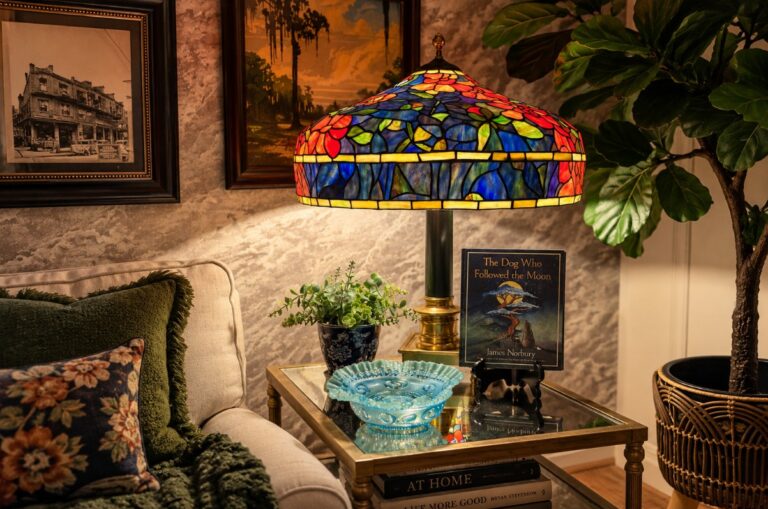
I once found an enormous Tiffany-style lamp in an antique store. Not tasteful-little-accent-lamp enormous. Lamp.
I had absolutely no idea where I was going to put it. Normally, this is where one might walk away.
Then I found out the price, and I knew with complete certainty that I was not leaving the store without that lamp. The location could be determined later.
This is a recurring feature of my decorating philosophy: Tomorrow’s DeAnn will handle logistics. Current DeAnn has found a lamp.
New things don’t usually find you
I buy new things too. There are times when I know exactly what I need. I search for it, compare options, order it and put it where I intended.
Efficient. Useful. Also considerably less likely to result in me whispering ohhh in the middle of a store.
Antiquing is different because I can’t search an inventory that hasn’t revealed itself yet. I have to encounter the thing. That’s part of the pleasure.
Sometimes I’m looking for an old book and find exactly the kind I’ve been hunting. Sometimes I’m looking for nothing and discover a lamp large enough to require its own zip code. The possibility is always there: there might be treasure.
And finding it feels different from ordering it. I saw it. I recognized it. I found it before somebody else did. Mine.
Apparently antiquing occasionally awakens the spirit of a small pirate.
I don’t want my home to look like I bought it all at once
I’ve lived in at least 13 states and in multiple places within many of them. My home reflects that.
The things I’ve collected didn’t all come from one region, one decade, one store or one version of me. Some pieces have followed me for years.
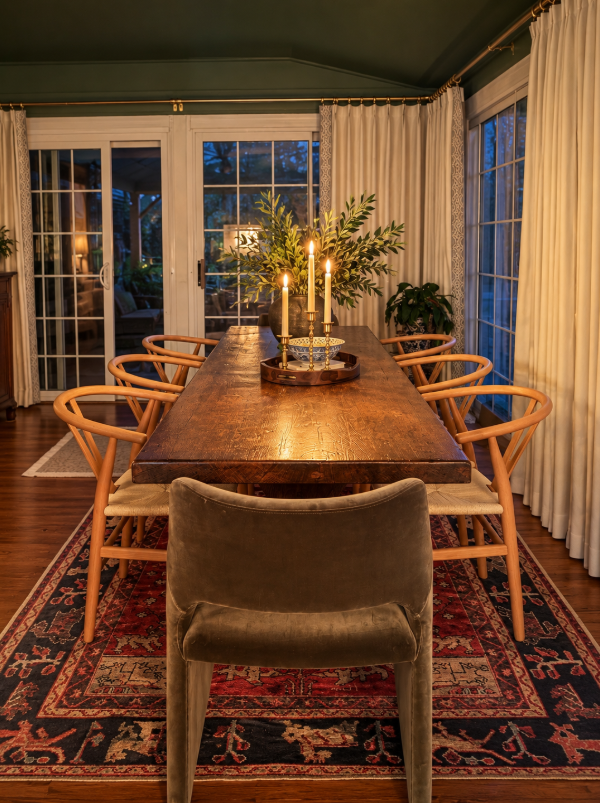
One of my favorites is an old French table from the 1800s that I bought while living in Southern California. It’s a massive piece of wood—heavy, solid and worn. The craftsmanship is remarkable.
I love its imperfections. Actually, I love them because they’re imperfections.
A pristine reproduction could imitate its shape and proportions. Someone could distress the wood in strategic places and give it a convincing aged finish, but it still wouldn’t be that table.
The wear on this one wasn’t designed. It happened because people used it. Then someone else did, and someone else after that.
I don’t know who those people were. I don’t know where the table originally stood or what happened around it. But sometimes I look at it and imagine the meals that must have been served there: ordinary dinners, celebrations, maybe arguments, children sitting at it, people leaning their elbows on the wood, someone spilling something and being annoyed about it.
Life.
Then, generations later and thousands of miles away, I found it in Southern California.
And it became part of mine.
I think that’s what “collected” means to me
I don’t want someone to walk into my house and feel as though they’ve already seen the room somewhere else. Not because everything needs to be rare or expensive. God knows it isn’t.
I just don’t want my home to feel as though I walked into a store, pointed at the display and said, I’ll take the room.
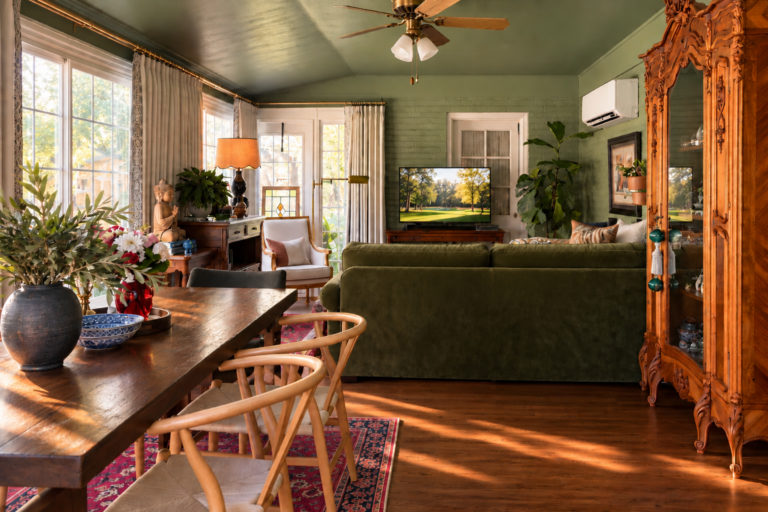
I want old beside new. Beautiful beside slightly strange. Polished beside worn. Things I deliberately searched for beside things I didn’t know I wanted until they called my name from across an antique booth.
That’s what makes a home feel collected to me.
But I’ve realized that collected means something more than an aesthetic. It’s chronological.
My home has accumulated over time because I have accumulated over time.
Different places. Different interests. Different versions of me. The objects came along.
Things move with us
Because I’ve moved so much, many of the things I own have lived in more than one home. They’ve occupied different rooms.
A piece that served one purpose in one house found another purpose somewhere else. Something bought for one particular spot eventually found itself somewhere I never would have imagined when I brought it home.
I remember where I found many of these pieces. If I don’t remember the exact store, I often remember the story.
I bought that when I lived in… I found that on the day we… That used to sit in… I had absolutely nowhere to put that.
The lamp would like the record to reflect that everything worked out.
Over time, the object becomes connected to more than the place where I found it. It becomes connected to the places I’ve taken it.
That’s something I hadn’t really considered until now.
An antique arrives with a life that happened before me. But if I keep it long enough, it starts accumulating mine too.
Maybe that’s why choosing five is unreasonable
I was asked which five antique or vintage pieces I would keep if I suddenly had to dramatically downsize.
My immediate response was:
Five per room, right?
This was apparently not the exercise.
But I stand by the question.
Because when I look around my home, I don’t see five Important Antiques surrounded by a bunch of interchangeable things. I see layers.
The old books I’ve been gathering. The oversized lamp I had no business buying without knowing where it would go. Furniture discovered in states I no longer live in. Small things I picked up because the internal deliberation lasted approximately four seconds: Yes.
And then another: Yes.
Not every object is precious. Not everything needs to come with me forever.
I can let things go. Eventually.
Let’s not get reckless.
But the pieces I love aren’t necessarily the most valuable ones. They’re the ones that feel like they belong to the story of the place and, increasingly, the story of me.
A home can’t be collected all at once
Maybe that’s why I don’t think a collected home is something you can simply buy.
You can certainly create the look of one. Designers do it beautifully. Mix eras. Add patina. Bring in something handmade. Layer old and new. All good advice.
But the part I love most can’t be ordered: time.
The ridiculous lamp you weren’t looking for. The table you found three states ago. The book about the county where you live now. The little thing you picked up because something inside you simply said yes.
The pieces move around. So do you.
They get scratched, rearranged, repaired and repurposed. They live in one room and then another, one house and then another, one state and then another.
Somewhere along the way, the things you brought home because they already had character begin acquiring something else: your history.
I still love imagining all the people who may have gathered around that old French table before it ever became mine. I’ll never know their stories.
But now the table has lived through some of mine.
That’s what I hadn’t understood when I bought it.
The things we collect don’t just come to us with stories. If we’re lucky enough to love them for a long time, they become witnesses to ours.
And occasionally, they begin their part of the story by whispering from the corner of an antique store:
DeAnn…I want to come home with you.
Yes. Obviously.